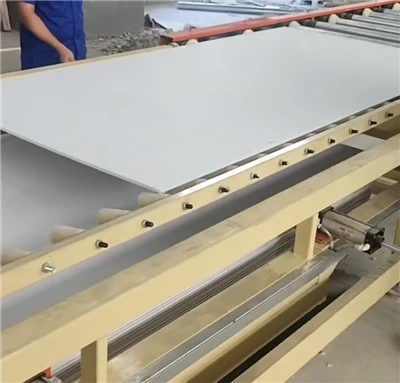

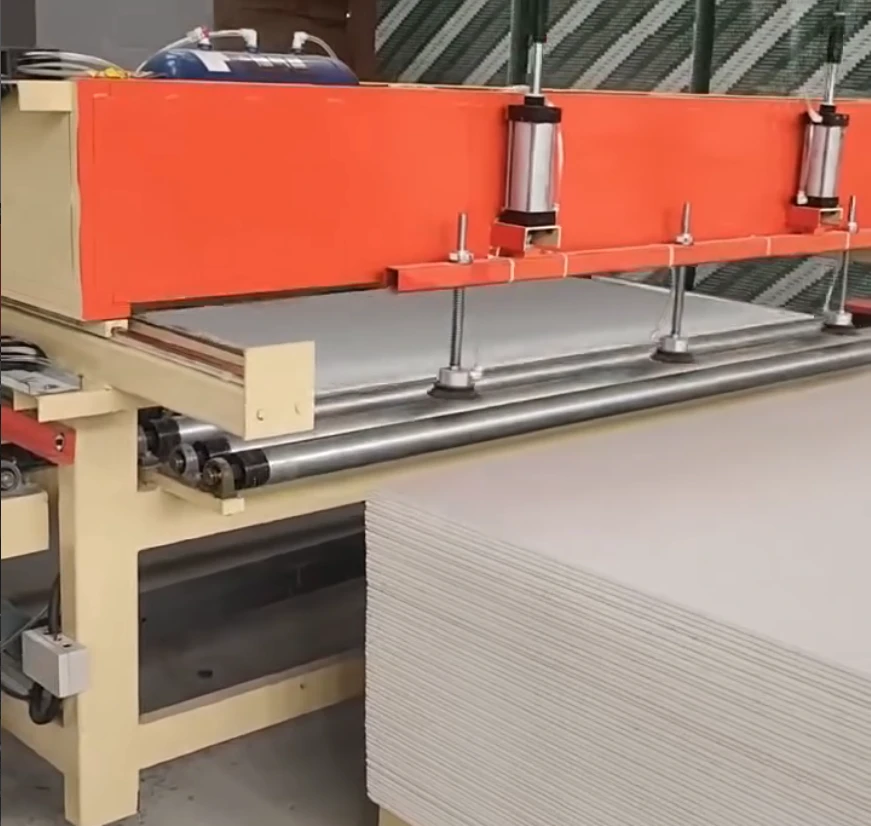
The global market for decorative plasterboard-such as PVC-faced acoustic tiles and foil-backed functional drywall-is expanding rapidly. To successfully manufacture these high-margin building materials without surface defects, plant managers must master the complex mechanical dynamics of the gypsum board lamination machine. Unlike laminating wood or plastic composites, plasterboard processing presents unique challenges, including heavy surface dust, residual core moisture, and brittle edges.
Below is an engineering analysis of the critical operational parameters and tension control mechanisms required to run a high-efficiency gypsum board lamination machine at zero-defect tolerances.
1. Thermodynamic Stabilization: The Pre-Heating Phase
One of the primary causes of premature film de-lamination is the thermal shock that occurs when room-temperature decorative film meets a cold gypsum core.
The Problem: Gypsum board naturally retains a microscopic moisture layer on its surface, which can vaporize under hot adhesives, creating trapped air blisters.
The Mechanical Solution: Advanced lamination lines incorporate an integrated infrared (IR) pre-heating tunnel ahead of the glue application zone. This system raises the board's surface temperature to an optimized 45°C - 55°C.
The Result: Pre-heating flashes off surface micro-moisture and opens up the gypsum face pores, drastically improving the mechanical interlocking bond of the adhesive.
2. Micro-Dosing Adhesive Calibration: PUR vs. Water-Based Systems
Achieving a flawless surface texture depends heavily on the adhesive delivery sub-system within the gypsum board lamination machine. Fluid dynamics must be strictly controlled based on the chemistry used:
PUR (Polyurethane Reactive) Hot-Melt Systems: PUR is the global standard for high-end panels due to its absolute water resistance. The machine must utilize a precision scrapper blade or slot-die applicator to apply a microscopic layer of 30 - 50 g/m². Applying too much creates "glue lines" visible through thin PVC film; applying too little causes edge curling.
Water-Based Acrylic Systems: More economical but requires an extended drying matrix. The machine's rubber anilox rollers must distribute the adhesive uniformly, and the line speed must be perfectly paired with flash-off fans to ensure water evaporates before the film is pressed down.
3. Closed-Loop Magnetic Particle Tension Control
When running thin decorative foils (0.08mm - 0.18mm PVC or PET) at high linear speeds, maintaining perfect web tension is incredibly difficult. If the film is unreeled too loosely, wrinkles form; if it is pulled too tightly, the film stretches and will later shrink, causing the finished gypsum board to warp or warp at the edges.
To prevent this, a professional gypsum board lamination machine utilizes a closed-loop tension control system:
Dancer Rollers & Ultrasonic Sensors: These continuous tracking elements measure the precise slack of the decorative film web in real-time.
Magnetic Particle Brakes: These brakes automatically adjust the unwinding resistance on the foil spindle based on data from the sensors.
Tension Synchronization: As the film roll decreases in diameter, the system decreases braking torque proportionally, ensuring uniform linear tension from the first meter of the roll to the last.
4. Calendering Architecture and Pressure Zoning
The final bonding matrix occurs within the multi-stage calendering (pressing) rollers. Plasterboard is prone to fracturing under concentrated vertical pressure, meaning standard heavy industrial rollers cannot be used.
Dual-Material Roller Arrays: The machine configuration must utilize a combination of heavy steel core rollers (for structural flattening) paired with specialized high-elasticity silicone or NBR rubber rollers (Shore A hardness 60-70).
Progressive Pressure Zoning: Pressure must be applied progressively across 3 to 5 roller stations. The initial zone applies light pressure to tack the film down without displacing glue, while successive zones increase compression force up to 3-5 kg/cm² to fully cure the bond and wrap the long edges cleanly.
Summary for Plant Operators
Optimizing a gypsum board lamination machine requires balancing board temperature, microscopic adhesive dosing, continuous film web tension, and progressive roller calibration. When these four mechanical systems are synchronized via a central PLC framework, production plants can safely maintain high linear output speeds while eliminating surface bubbles, edge delamination, and structural warping.