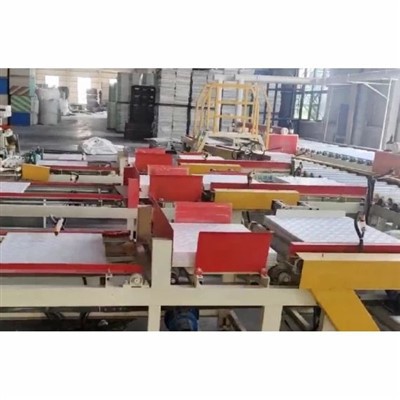

The global demand for cost-effective, aesthetic, and functional suspended ceilings has positioned PVC faced gypsum ceiling tiles as a leading choice for modern interior decoration. Commonly seen in commercial offices, supermarkets, schools, and hospitals, these tiles offer an ideal balance of moisture resistance, thermal insulation, and easy maintenance.
For building material manufacturers looking to enter or expand within this lucrative market, understanding the core manufacturing technology-specifically the PVC Faced Gypsum Ceiling Tile Machine-is the first step toward a high-return investment.

What is a PVC Faced Gypsum Ceiling Tile Machine?
A PVC faced gypsum ceiling tile production line is a highly integrated, automated system designed to transform standard, large-size gypsum boards (such as 1220×2440mm) into smaller, laminated, and edge-taped ceiling squares (typically 600×600mm or 595×595mm).
Instead of manual lamination, which is slow and prone to air bubbles, this industrial line performs automatic cleaning, gluing, PVC filming, aluminum foil backing, precision multi-blade sawing, and edge sealing in one continuous workflow.
The Step-by-Step Manufacturing Process
A professional-grade production line utilizes a synchronized conveyor system to guide the boards through several critical phases:
Board Feeding & Surface Cleaning
High-efficiency blowers and rotating brush rollers remove all gypsum dust and loose particles from both sides of the base board. A perfectly clean surface is vital for maximum glue adhesion.
Dual-Side Gluing & Lamination (The Core Phase)
Front Side (PVC Film): The machine applies a uniform layer of specialized water-based or hot-melt adhesive. A decorative, anti-static PVC film is then unrolled and pressed onto the front surface using heavy-duty rubber laminating rollers.
Back Side (Aluminum Foil): Simultaneously or sequentially, a layer of protective aluminum foil is laminated to the back of the board. This foil acts as a critical vapor barrier, preventing moisture from penetrating the gypsum core from the ceiling plenum.
Automatic Drying & Curing
The laminated boards pass through a heated drying tunnel or a curing conveyor framework to ensure the adhesive sets completely before the cutting stage.
High-Precision Multi-Blade Sawing (Size Reduction)
The large laminated board is automatically turned 90 degrees and fed into two sets of heavy-duty, multi-blade ripping saws. It is cleanly sliced into standard dimensions such as 595×595mm, 600×600mm, or 603×603mm with a tolerance of less than ±0.5mm.
Automatic Edge Taping & Sealing
Gypsum edges are inherently dusty and fragile. The sliced tiles instantly enter the edge-banding section where a specialized PVC or aluminum tape covers all four exposed raw edges. This seals in the gypsum dust and prevents edge chipping during transportation and installation.
Dust Collection & Auto-Stacking
Throughout the cutting process, a powerful industrial dust extraction system captures all gypsum powder. Finally, a vacuum-sucker robot or a mechanical lift stacks the finished tiles neatly onto pallets for packaging.
Key Technical Considerations for Buyers
When sourcing a PVC gypsum ceiling tile machine, experienced factory owners focus on three critical technical aspects rather than just the lowest price:
Roller Precision and Pressure Balance: If the laminating rollers do not apply equal pressure across the 1.22-meter width, the PVC film will develop wrinkles or air pockets over time.
Saw Blade Stability: Gypsum is highly abrasive. High-speed, tungsten-carbide-tipped (TCT) diamond saw blades coupled with heavy-duty spindles are required to ensure clean cuts without tearing the newly applied PVC film.
Adhesive Compatibility: Choosing between traditional white glue (PVAC) and advanced hot-melt PUR systems affects both the machine configuration (heating requirements) and the final tile's heat resistance in tropical climates.
Elevate Your Production Capabilities
Investing in a modern, automated PVC faced gypsum ceiling tile line allows manufacturers to minimize labor costs, drastically reduce material scrap rates, and deliver products that meet rigorous international commercial building codes.