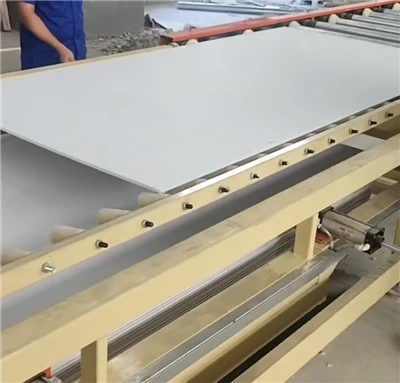

Premium PVC‑faced gypsum boards feature flame‑retardant and eco‑friendly substrates alongside water‑resistant and attractive surface layers. Their quality relies entirely on standardized automated manufacturing procedures. The core production‑line workflows are broken down below to illustrate the complete board‑making process.
Pretreatment Through Raw‑Material Proportioning
Intelligent equipment precisely meters raw materials including gypsum powder, PVC pellets and adhesives. Impurity removal, drying and homogeneous mixing are carried out to optimize the substrate structure and root‑out common defects such as hollow sections, cracks and delamination.
Roller Compaction and Substrate Forming
Mixed slurry is automatically spread. Closed‑loop pressure‑controlled roller pressing compacts and shapes the mixture into high‑density, flat and uniform gypsum board blanks, laying a solid foundation for the subsequent film‑laminating process.
High‑Pressure Film Lamination
Machinery automatically feeds PVC film. Eco‑friendly glue application and constant‑temperature high‑pressure bonding enable seamless adhesion between film and board free of air bubbles and wrinkles. Embossing, printing and other decorative treatments can be completed concurrently.
Constant‑Temperature Drying and Curing
A low‑temperature slow‑curing process maintained between 50℃ and 60℃ tightly bonds the surface film to the base board. It effectively prevents edge warping, deformation and cracking, improves moisture and ageing resistance and extends service life.
Precision Cutting and Quality Inspection
Once boards cool and set, automated trimming cuts them into standard dimensions and removes burrs. Intelligent inspection screens out defective items. Qualified finished products are automatically transported to the warehouse, marking the completion of the whole standardized production workflow.