
The global demand for suspended ceiling grid systems is skyrocketing, fueled by massive commercial infrastructure developments, office renovations, and modern residential construction. For building material manufacturers and investors looking to enter or expand in this sector, the message is clear: traditional, low-speed manufacturing can no longer compete.
As a premier manufacturer of industrial roll forming machinery, we explore how upgrading to a modern fully automatic ceiling T-grid production line is changing the financial landscape for factory owners worldwide and maximizing their Return on Investment (ROI).

1. Eliminating Labor Costs Through Total Line Integration
In the past, manufacturing Main Tees, Cross Tees, and Wall Angles required multiple separate setups, manual feeding, and intensive labor for cutting and punching hooks. This not only slowed down production but also introduced a high margin of human error.
Our latest high-speed T-grid production lines utilize fully integrated Siemens or Mitsubishi PLC systems. The entire process-from decoiling and high-speed flying punching to continuous roll forming and non-stop hydraulic cutting-requires only 1 to 2 operators. By drastically lowering overhead labor costs, factories can reallocate resources to market expansion.
2. Speed and Precision: The Secret to High-Volume Orders
In the B2B construction supply chain, speed wins contracts. When a distributor needs thousands of linear meters of T-grid for a skyscraper project, a standard 15m/min machine simply cannot deliver on time.
Modern engineering has pushed stable production speeds up to 35–40 meters per minute. Combined with high-precision servo-feeding and alloy steel punching dies, the production line guarantees that every interlock click-mechanism (end clip) is punched with millimeter accuracy. This ensures flawless, rapid on-site assembly for the end-user, boosting your brand's reputation for premium quality.
3. Material Efficiency and Scratch-Free Tech
With steel coil prices constantly fluctuating, material waste can eat directly into a manufacturer's profit margins. Advanced flying cut-off systems ensure zero-waste cutting, ensuring every millimeter of Prepainted Galvanized Steel (PPGI) is utilized.
Furthermore, customized roller engineering utilizes vacuum-quenched Cr12/GCr15 rollers with hard chrome plating. This prevents any surface scratching on the painted face of the T-grid, completely eliminating product rejection rates and ensuring a pristine matte-white finish every single run.
4. Meeting Diverse Market Demands (Customization)
The global market does not use a single uniform T-grid size. Europe, the Middle East, and Southeast Asia all have slight variations in profile heights (e.g., 38mm vs. 32mm) and widths (24mm standard vs. 15mm slim line).
Investing in a versatile production line allows manufacturers to adapt quickly. With cassette-type roller designs or easily adjustable forming stations, switching between different profile specifications becomes seamless, allowing your factory to cater to both local and export market standards simultaneously.

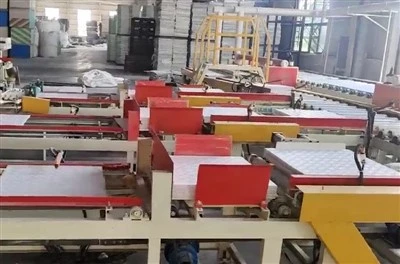
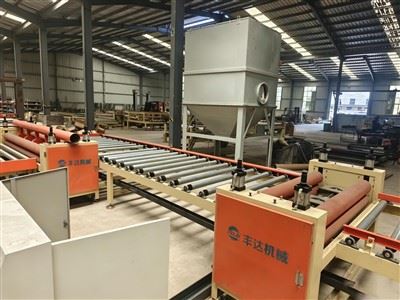
To support the booming global market, our workshop has recently dispatched three complete, custom-engineered Ceiling T-Grid Roll Forming Lines to clients in Southeast Asia and South America. Each line underwent a rigorous 24-hour continuous dry-run test before receiving its export-standard seaworthy packaging certification.