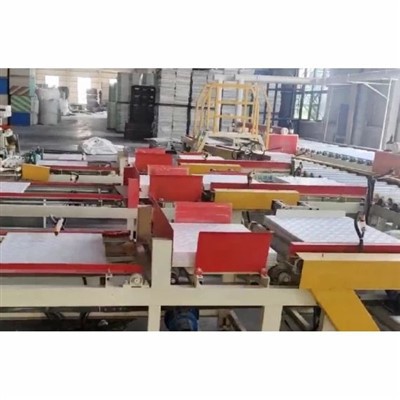

If you are setting up a PVC gypsum ceiling tile production line for the first time - or looking to upgrade your existing setup - understanding how a gypsum ceiling tile cutting and laminating machine works, what separates a good one from a poor one, and what questions to ask before you buy will save you from the most expensive mistakes first-time factory owners make.
Why This Machine Is the Heart of Your Production Line
A PVC gypsum ceiling tile production line has many components - board feeding, pre-heating, foil lamination, packing, heat shrink. But the cutting and laminating stage is where product quality is either secured or lost.
Every tile that reaches your customer has passed through this machine. If the lamination bond is weak, the PVC film peels. If the cutting tolerance is off, the tile does not fit the T-grid. If the surface is scratched during the transition between lamination and cutting, the tile is unsaleable. No amount of inspection at the packing stage can fix a quality problem that originates here.
This is why choosing the right cutting and laminating system is the most important equipment decision you will make.

How the Machine Works - Step by Step
Understanding the production process helps you evaluate machines accurately and identify problems early when they occur.
Stage 1 - Pre-heating
The gypsum board surface is heated to the correct bonding temperature before the PVC film makes contact. If the board enters the lamination zone at the wrong temperature - too cold or too hot - the bond will be inconsistent regardless of how much pressure is applied. Pre-heating is the step most factory owners underestimate.
Stage 2 - PVC Film Lamination
The decorative PVC film is unwound from the roll and pressed onto the board surface under controlled heat and pressure through a series of lamination rollers. The key variables are temperature, pressure and speed - and they must be calibrated together, not independently. Changing one without adjusting the others is the most common cause of lamination defects including bubbling, edge lifting and uneven pattern depth.
Stage 3 - Transition and Cooling
After lamination, the board must be guided smoothly into the cutting zone without any gap, drop or change of direction. This transition section is where poorly engineered machines create surface scratches and dimensional shifts - the board moves slightly out of position, and every subsequent cut is off-spec.
Stage 4 - Precision Cutting
The laminated board is cut to the final 600×600mm dimension. The cutting system must maintain a tolerance of ±0.5mm across every tile in every batch. Blade sharpness, blade alignment and feed speed are the three variables that determine whether this standard is met consistently.
Five Specifications That Actually Matter
When evaluating a gypsum ceiling tile cutting and laminating machine, most buyers focus on output speed and price. Those matter - but they are not what determines whether your tiles pass buyer inspection six months after installation.
① Lamination Temperature Range and Control Precision
The machine should support a lamination temperature range of 100–160°C with control precision of ±2°C. If the temperature drifts more than this between the start and end of a production run, bond strength will vary across the batch.
② Cutting Dimensional Tolerance
Ask for the manufacturer's stated cutting tolerance and then ask how it is verified. The standard is ±0.5mm on all four sides. Any supplier who cannot give you a specific number is not a supplier you should trust with this purchase.
③ Roller Material and Surface Hardness
The lamination rollers are the highest-wear component in the machine. Rollers made from hardened steel with a surface hardness of HRC 55–60 maintain their geometry significantly longer than softer alternatives. Ask what the expected roller replacement interval is under your target production volume.
④ Transition Zone Design
This is the specification most buyers never ask about - and the one that causes the most problems. The board support surface between the lamination exit and the cutting entry must be continuous, flat and precisely level. Ask the supplier to show you this section of the machine specifically and explain how it prevents misalignment.
⑤ Blade Replacement Frequency and Cost
Cutting blades wear. On a well-designed machine running standard 7–9mm gypsum board, blade replacement should be required every 50,000–80,000 cuts under normal operating conditions. Ask for the replacement cost and lead time - if spare blades are not locally available and take three weeks to ship, a blade failure stops your entire production line.
The Three Most Common Buying Mistakes
Based on the experience of factory owners across Africa, Latin America and the Middle East who have invested in ceiling tile production equipment, these are the three mistakes that cause the most problems after installation.
Mistake 1: Choosing based on the lowest machine price
The cheapest machine in any equipment category is cheap for a reason. In cutting and laminating equipment, low price almost always means lower-grade roller materials, less precise temperature control and a transition zone design that causes surface damage. The additional defect rate and rework cost will exceed the price saving within the first three months of production.
Mistake 2: Not verifying output claims under real conditions
A supplier who quotes 6,000 tiles per shift is quoting their best-case number. Ask to see video evidence of the machine running at that output in an existing customer factory - not their own showroom. Showroom conditions are controlled. Real factory conditions are not.
Mistake 3: Ignoring after-sales support
The machine will need adjustment, recalibration and eventually component replacement. A supplier who cannot offer remote technical support within 24 hours and spare parts delivery within a reasonable timeframe is not a viable long-term partner - regardless of how good the machine looks on paper.
What a Complete Support Package Should Include
When you invest in ceiling tile production equipment, you are not just buying a machine. You are building a manufacturing capability. The support package around the machine is what determines whether that capability becomes productive quickly or struggles through months of trial and error.
A complete support package from a reputable supplier should include on-site installation and calibration by the supplier's engineering team, operator training covering machine setup, daily operation, quality checks and basic maintenance, raw material sourcing guidance for PVC film and aluminium foil compatible with the machine's specifications, remote technical support available by video call throughout the warranty period, and a spare parts package covering the highest-wear components including blades, rollers and heating elements.
If a supplier is unwilling to provide all of these as standard - not as paid add-ons - keep looking.
SUMMARY
The decision to invest in a gypsum ceiling tile cutting and laminating machine is one of the most consequential investments a ceiling tile factory owner will make. Get it right - by evaluating the specifications that actually determine quality, asking the questions that reveal a supplier's real capabilities, and choosing a partner who supports you through installation and beyond - and this machine will be the foundation of a profitable, scalable production operation for years to come.
ENJOY supplies complete PVC gypsum ceiling tile production lines including integrated cutting and laminating systems, with full installation, operator training, raw material sourcing support and after-sales technical service to customers across Africa, the Middle East, Latin America and Central Asia.