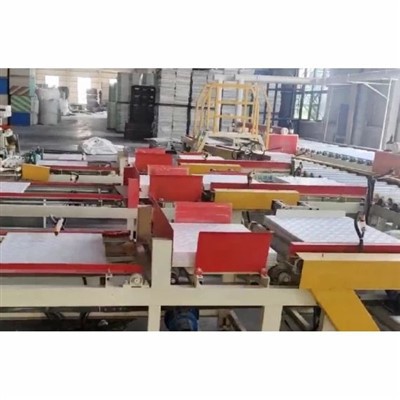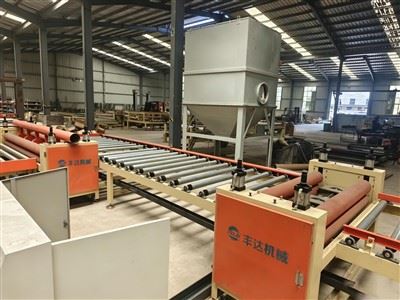

As global demand for moisture-resistant, aesthetic, and cost-effective suspended ceilings continues to rise, PVC laminated gypsum ceiling tiles have become a staple in commercial and residential construction. To stay competitive and maximize profit margins, building material manufacturers are increasingly upgrading to a good quality fully automatic PVC lamination gypsum tile machine.
However, not all laminating machines deliver the same performance. Investing in low-end equipment often leads to film peeling, high glue consumption, uneven cutting, and frequent downtime. Below is a practical guide on what defines a high-quality machine and how to select the right system for your factory.

1. Key Features of a Good Quality Fully Automatic Machine
When evaluating different machinery suppliers, look closely at the following core engineering standards:
Heavy-Duty Machine Frame: A reliable production line is built with thickened, stress-relieved steel plates. This prevents vibration during high-speed operation and ensures long-term mechanical stability.
Precision Glue Coating System: High-grade chrome-plated steel rollers paired with EPDM rubber rollers guarantee uniform glue distribution. This eliminates bubbles, saves 15%–20% on adhesive costs, and ensures strong bonding even in humid climates.
Synchronous Double-Sided Lamination: A top-tier machine laminates decorative PVC film on the front and moisture-proof aluminum foil on the back simultaneously with automatic tension control, preventing board warping or film wrinkling.
High-Speed Servo Cutting System: Equipped with tungsten carbide saw blades and precision linear guides, a quality cutting unit achieves dimensional accuracy within ±0.2mm-crucial for seamless installation into standard T-bar ceiling grids.
Smart PLC Automation: With an integrated PLC control system (such as Siemens or Mitsubishi) and user-friendly touchscreen, the entire process-from automatic feeding and dust removal to laminating, cutting, stacking, and shrink-wrapping-runs smoothly with only 3 to 4 operators.
2. Semi-Automatic vs. Fully Automatic: Why Full Automation Wins
For factories aiming for medium-to-large scale production, choosing a fully automatic PVC lamination gypsum tile machine offers clear operational advantages over manual or semi-automatic setups:
| Feature | Semi-Automatic Line | Good Quality Fully Automatic Line |
|---|---|---|
|
Daily Output (8 Hours) |
1,500 – 2,200 sqm | 4,000 – 6,000+ sqm |
|
Labor Required |
8 – 12 workers | 3 – 4 operators |
|
Cutting Precision |
Moderate (manual alignment) | High (±0.2mm servo-controlled) |
|
Material Waste Rate |
3% – 5% | Less than 1% |
|
Long-Term ROI |
Slower due to high labor costs | Fast payback (typically 6–12 months) |
3. Essential Checklist Before Purchasing
To ensure you get a good quality fully automatic PVC lamination gypsum tile machine tailored to your market, verify these details with your manufacturer:
Tile Size Flexibility: Can the cutting system easily switch between popular export sizes like 595×595mm, 600×600mm, and 603×603mm (2'×2')?
Adhesive Compatibility: Is the gluing unit optimized for your preferred adhesive (such as PVA white latex or PUR hot-melt glue)?
Core Electrical & Pneumatic Components: Are internationally recognized brands used for motors, inverters, bearings, and sensors to ensure easy local maintenance?
Turnkey Engineering Support: Does the supplier provide factory layout CAD drawings, on-site installation, commissioning, and operator training?
Conclusion
Choosing a good quality fully automatic PVC lamination gypsum tile machine is an investment in consistent product quality, lower production costs, and higher factory output. By focusing on structural durability, gluing precision, and genuine PLC automation, manufacturers can quickly capture market share in both domestic and international building material markets.