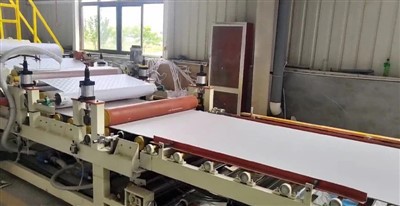

As commercial and residential construction continues to grow across developing and established markets, local demand for suspended ceiling grid systems (Main Tee, Cross Tee, and Wall Angle) has surged. For building material importers and wholesalers, investing in an Automatic Ceiling T Grid Production Line is one of the fastest ways to transition from trading to high-margin local manufacturing.
If you are planning to start a ceiling T-grid factory, here is a practical engineering guide covering machine selection, raw material specifications, and production capacity.

1. Essential Machinery Configuration for a Complete Factory
A standard suspended ceiling grid system consists of three profiles: Main Tee, Cross Tee, and Wall Angle (L-Angle). To produce all three efficiently, a complete plant typically includes:
1× Automatic Ceiling T Grid Production Line (Main Tee & Cross Tee): This is the core machine. By changing the hydraulic/servo punching dies and selecting the program on the PLC touch screen, one line can produce both Main Tee (3600/3660mm) and Cross Tee (1200/1220mm & 600/610mm).
1× Wall Angle Roll Forming Machine: Because Wall Angle has a simple L-shape without complex end-clip punching, using a dedicated, lower-cost roll forming machine runs at higher speeds (25–30 m/min) and frees up your main line for T-bars.
Optional – Steel Coil Slitting Machine: If you buy wide master steel coils (e.g., 1000mm or 1250mm wide) directly from steel mills to save raw material costs, a slitting line allows you to slit them into narrow strips (e.g., 32mm, 42mm, 64mm) in-house.
2. Raw Material Specifications (Galvanized & PPGI Coils)
Each T-bar is formed by cladding two steel strips together:
Inner Core Strip: Hot-dipped galvanized steel coil (GI), typically 0.23mm to 0.40mm thick depending on local load-bearing standards (light duty, medium duty, or heavy duty).
Outer Cap Strip: Pre-painted galvanized steel coil (PPGI) in matt white, glossy white, or black, typically 0.16mm to 0.25mm thick with a protective PE film to prevent scratching during roll forming.
3. Daily Output & Labor Calculation
With a modern Automatic Ceiling T Grid Production Line operating at an average speed of 18–22 meters/min:
Hourly Output: Approx. 1,080 – 1,320 meters/hour.
8-Hour Shift Output: Approx. 8,500 – 10,500 linear meters per day, which is enough to supply roughly 3,000 – 3,500 square meters of suspended ceiling grid installations daily.
Labor Needed: Only 1–2 operators are required per line (one to monitor coil feeding and PLC settings, and one to pack finished T-bars into cartons).
4. Workshop Space & Power Requirements
Recommended Workshop Size: At least 25m (Length) × 8m (Width) × 4.5m (Height) to accommodate the decoiler, main forming mill, run-out table, and raw material/finished goods storage.
Power Supply: Standard 380V / 50Hz / 3-Phase industrial power (customizable to 220V/415V/440V 60Hz upon request), with total power consumption around 12–18 kW.
Conclusion
Setting up an Automatic Ceiling T Grid Production Line requires a relatively compact workshop and minimal labor, offering a fast return on investment-especially when paired with suspended PVC gypsum ceiling tiles to offer a one-stop ceiling package to your buyers.