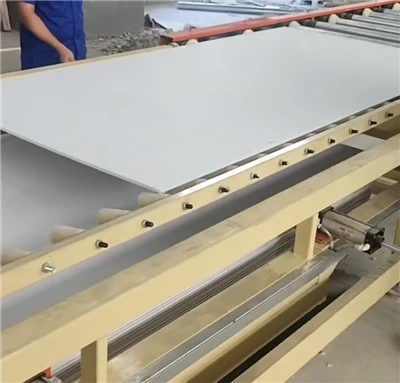

Decorative gypsum board is a material primarily composed of gypsum board, used for ceiling or wall decoration. It is lightweight, heat-insulating, non-combustible, sawable and nailable, sound-absorbing, moisture-regulating, and aesthetically pleasing.
Based on the shape of the front surface and its moisture-proof performance, decorative gypsum board is divided into two categories: Ordinary board and moisture-resistant board. Ordinary board includes three types: Ordinary flat board (code P), ordinary perforated board (code K), and ordinary embossed board (code D). Moisture-resistant board also includes three types: Moisture-resistant flat board (code FP), moisture-resistant perforated board (code FK), and moisture-resistant embossed board (code FD).
The quality grade of decorative gypsum board is determined based on dimensional tolerances and unevenness. Appearance quality requirements stipulate that the front surface of the decorative gypsum board should be free of defects that affect the decorative effect, such as air holes, stains, cracks, missing corners, uneven color, and incomplete patterns. Regarding dimensional tolerances, the thickness should be the distance between the front and back of the board, excluding chamfered edges, holes, and embossed patterns.
According to national environmental protection standards, the radioactivity levels of ceiling materials are classified into three categories (mainly applicable to non-metallic, non-organic ceiling materials, such as gypsum board). Category A decorative materials have no restrictions on production, sales, or use. Category B decorative materials cannot be used for interior finishes in Category I civil buildings. Category C decorative materials can only be used for exterior finishes and other outdoor applications.