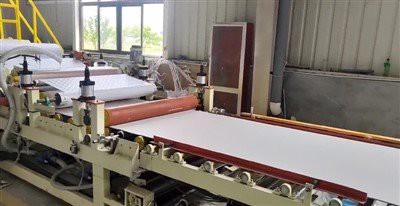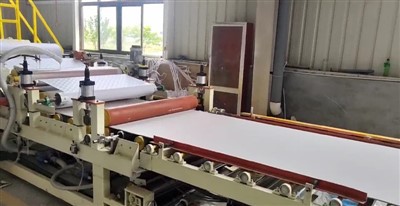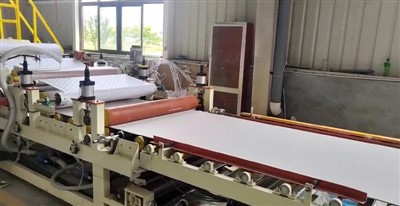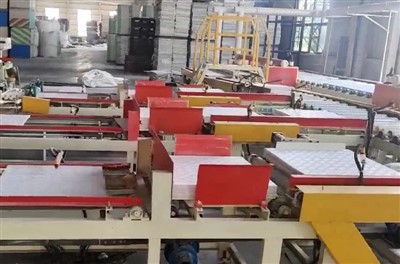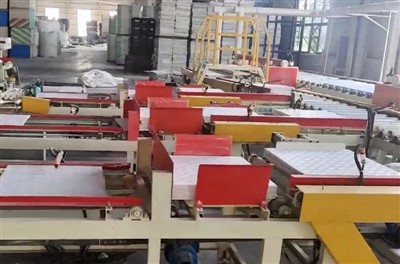

At the core of the technical system for a modern paper-faced gypsum board production line lies a comprehensive framework that integrates automated control, intelligent monitoring, and information management.
Monitoring System
The production line monitoring system can adopt a software architecture based on Cimplicity HMI. It facilitates plant-level data transmission via a redundant fiber-optic ring industrial Ethernet network, while device-level data transmission is handled through the Profibus-DP fieldbus. The supervisory monitoring software is capable of simultaneously accessing PLC systems from various manufacturers via an OPC interface.
Control System and Network Architecture
The control system is designed around industrial networks-specifically fieldbuses and industrial Ethernet-and is underpinned by in-depth research into the PROFIBUS-DP communication protocol as well as the real-time capabilities and reliability of industrial Ethernet. For the control of critical stages-such as the cutting process-solutions based on servo controllers and Programmable Logic Controllers (PLCs) can be employed. By applying theoretical research and precise control to the cutting blade's trajectory, high-precision cutting results are guaranteed.
Intelligent Maintenance and Management System
An advanced equipment predictive maintenance system enables the electronic and digital management of processes such as equipment asset tracking, routine inspections, lubrication scheduling, and repairs. By collecting and analyzing operational status data-including rotational speed, vibration, temperature, and current-and utilizing artificial intelligence algorithms to construct intelligent diagnostic models, the system achieves early warning detection for potential anomalies and predictive fault analysis, thereby enhancing equipment reliability. Environmental protection zones-such as those dedicated to desulfurization and denitrification-can be equipped with a Distributed Control System (DCS). This enables the automatic collection and statistical analysis of operational data, real-time panoramic visualization of equipment status, precise control over chemical dosing, and the storage of online emission data, thereby ensuring the stable and compliant operation of environmental protection facilities.
Automation and Intelligent Applications
The production line is evolving rapidly toward a state of high automation and intelligence. The batching and forming systems feature "one-touch start" capabilities, with all raw materials fed automatically under PLC control; these systems are also equipped with alarm mechanisms to signal material shortages or interruptions [13]. In the packaging stage, intelligent equipment-such as automatic spacer destackers, fully automated stretch-wrapping robots, and automatic edge-banding and strapping machines-can be deployed. This enables the automated destacking of materials and the automatic placement and application of protective covers and labels, thereby significantly reducing labor intensity while enhancing packaging precision and consistency.