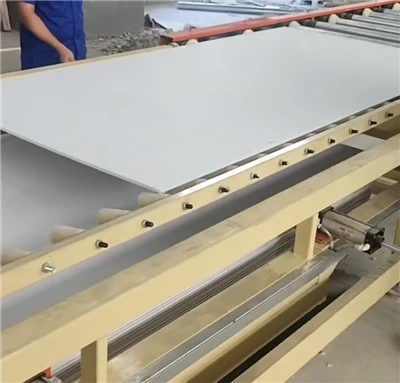

Gypsum board is a lightweight building board made primarily of natural gypsum and facing paper, with the addition of appropriate amounts of fiber, starch, accelerators, foaming agents, and water. It has the following performance characteristics:
Low Energy and High Efficiency: The energy consumption for producing the same unit of gypsum board is 78% lower than that of cement. It requires less investment, has a large production capacity, and a simple process, facilitating large-scale production.
Lightweight: Using gypsum board for partition walls results in a weight that is only 1/15 that of a brick wall of the same thickness and 1/10 that of a block wall. This is beneficial for structural earthquake resistance and can effectively reduce the cost of foundations and the main structural components.
Thermal Insulation: Approximately 60% of the core of gypsum board is composed of micropores. Due to the low thermal conductivity of air, it possesses excellent lightweight thermal insulation properties.
Fire Resistance: Since the gypsum core itself is non-combustible, and it absorbs a large amount of heat during the release of chemically bound water when exposed to fire, delaying the rise in ambient temperature, gypsum board exhibits excellent fire-retardant properties. According to tests conducted by the National Fire Protection Testing Center, the fire resistance rating of gypsum board partition walls can reach 4 hours.
Sound Insulation Performance: Single-layer walls constructed from a single lightweight material, such as aerated concrete or expanded perlite board, require significant thickness to meet sound insulation requirements. Gypsum board partition walls, however, possess a unique cavity structure, resulting in excellent sound insulation performance.
Decorative Function: The smooth surface of gypsum board, with seamless joints between boards, allows for direct decoration.