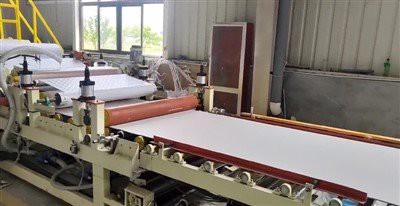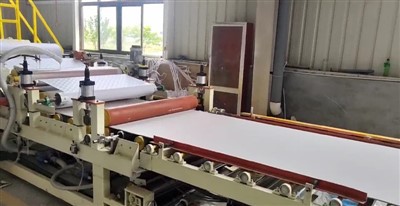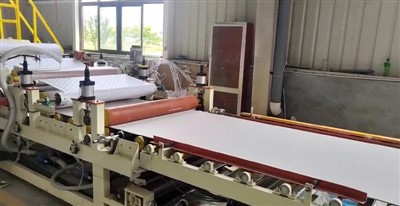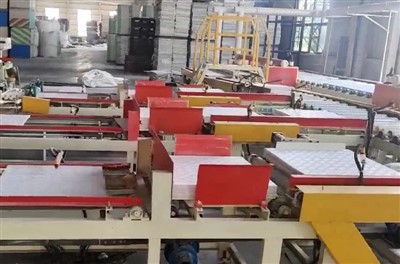

PVC gypsum board is a lightweight building board made primarily from natural gypsum and facing paper, with the addition of appropriate amounts of fiber, starch, accelerators, foaming agents, and water. As a new type of building material, PVC gypsum board is widely used in decoration and construction. Today, we'll introduce the characteristics of PVC gypsum board.
PVC gypsum board panels do not contain toxic substances and are environmentally friendly, healthy, moisture-proof, anti-sagging, non-deformable, heat-insulating, radiation-proof, and easy to clean. They come in a wide variety of colors and patterns, are fireproof, waterproof, dustproof, insect-proof, stylish, environmentally friendly, offer rich finishes, and are easy to install. They also have a certain temperature-regulating effect on indoor spaces, are beneficial to human health, and are an ideal green building material. Their beautiful and elegant designs surpass even the most exquisite works of art! They are widely applicable to the interior decoration of hotels, restaurants, shopping malls, theaters, dance halls, stations, auditoriums, rooms, living rooms, office buildings, electronic machine rooms, precision instrument rooms, factories, and residences.
They have low energy consumption and high production efficiency. The energy consumption for producing the same unit of PVC gypsum board is 78% lower than that of cement. It also boasts high production capacity in smaller quantities, simple processes, and ease of large-scale production.
Good fire resistance: Because the gypsum core itself is non-combustible, and absorbs a large amount of heat during the release of chemically bound water when exposed to fire, it delays the rise in ambient temperature. Therefore, PVC gypsum board has excellent fire-retardant properties.
Lightweight and thermally insulating: Using PVC gypsum board for partition walls results in a weight that is only 1/15 of a brick wall of the same thickness and 1/10 of a block wall. This is beneficial for structural earthquake resistance and can effectively reduce the cost of foundations and the main structure. Approximately 60% of the PVC gypsum board core is composed of micropores; due to the low thermal conductivity of air, it has excellent lightweight thermal insulation properties.
Good sound insulation: Single-layer walls made of a single lightweight material, such as aerated concrete or expanded perlite board, require a large thickness to meet sound insulation requirements. PVC gypsum board partition walls, with their unique cavity structure, offer excellent sound insulation performance.
Easy to process and highly workable: PVC gypsum board is nailable, planable, sawable, and adhesive, making it ideal for interior decoration. It can be easily cut with just a cutting knife, facilitating construction and significantly improving efficiency.
Green and environmentally friendly: PVC gypsum board uses natural gypsum and PVC as raw materials and contains no asbestos (most calcium silicate boards and cement fiberboards use asbestos as a reinforcing material).
Space-saving: Using PVC gypsum board for walls allows for a wall thickness of up to 74mm while maintaining sound insulation and fire resistance. Due to its lightweight, fire resistance, sound insulation, heat insulation, excellent workability (planable, nailable, sawable), ease of construction, and good disassembly and assembly capabilities, PVC gypsum board is widely used in various industrial and civil buildings, especially in high-rise buildings as an interior wall and decorative material. For example, it can be used in non-load-bearing walls, interior paneling, and suspended ceilings in cabinet structures.