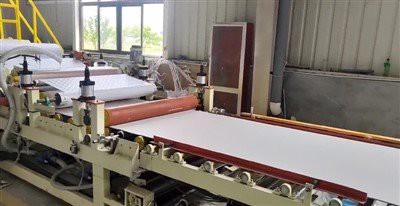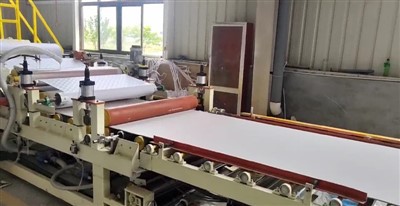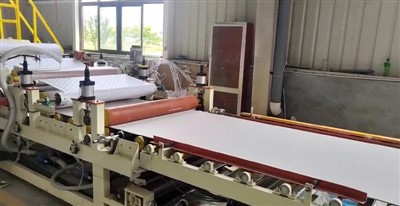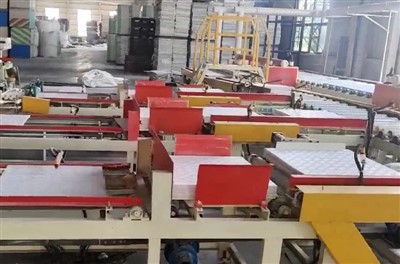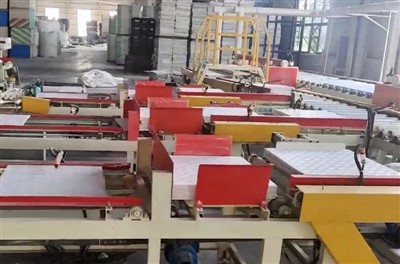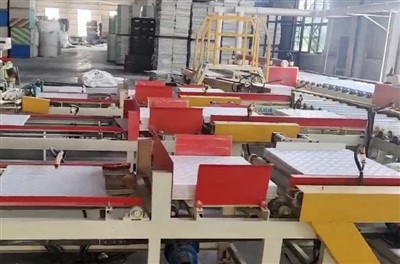

The gypsum board production line is a core piece of equipment in the building materials processing industry for the large-scale production of gypsum board. It transforms gypsum raw materials into boards that meet building standards through an automated process. Its core functions include raw material mixing, molding, drying, and cutting. It is suitable for interior partitions, ceilings, and other applications, with particular emphasis on fire resistance and moisture resistance. This equipment achieves high-efficiency production through modular design, with a short molding cycle, meeting the needs of large-scale building materials supply.
Technical Principles and Core Components: The core process of the gypsum board production line is divided into three stages: Raw material processing, molding, and drying. In the raw material processing stage, a high-speed mixer thoroughly mixes gypsum powder, water, and additives to form a uniform slurry. In the molding stage, a conveyor belt evenly spreads the slurry into the molding mold. The main vibration system (vibration mode) eliminates air bubbles through high-frequency vibration, ensuring the density of the boards. The drying stage uses hot air circulation technology to complete preliminary curing within a 60-second molding cycle. Finally, a cutting device obtains standard-sized boards. Key components of the equipment include a 30kW power drive system, a 2.0-meter-high welded profile frame, and a corrosion-resistant conveyor belt, weighing 25 tons to ensure operational stability.
Operation and Production Advantages: The operation process covers four steps: parameter preset, raw material feeding, equipment start-up, and quality monitoring. Users need to adjust the conveyor belt speed and vibration frequency according to the required sheet thickness and set the drying temperature (usually 80-120℃) via the control panel. Compared to traditional manual production, this equipment achieves full automation, reducing the molding cycle from 5 minutes to 60 seconds and increasing daily capacity by 300%. The main vibration mode controls the density uniformity error of the sheet within ±2%, significantly reducing the risk of cracking. It also supports customized fireproof and moisture-proof formulas to adapt to different climate regions.
Technical Parameters and Applicable Scenarios: The equipment is supplied to the national market through a domestic trade model. Key parameters include: 30kW power to meet continuous production energy consumption requirements; 2.0-meter profile height to adapt to standard factory floor heights; and 25-ton self-weight to ensure high-speed operation stability. Its application scenarios cover commercial building partition systems, residential decoration ceiling projects, and industrial plant fire compartments, especially suitable for projects with high construction efficiency requirements. The equipment supports non-standard customization and can be expanded to concrete machinery production lines, allowing for rapid switching of production types through modular components.